AI Agents vs. Skills: The Difference, Finally Explained (by Someone Who Teaches It Weekly)

A few weeks ago, in one of my agent-building workshops, a sharp student stopped me mid-session.
She wanted to lock down the difference between an agent and a skill.
I gave her an explanation.
She pushed back.
I gave her a second explanation, with a live example from my own system.
Still not locked.
I gave her a third.
And then she said the sentence that has stayed with me since: “I understand what you’re saying. But what’s the practical implication?”
Seven minutes, three explanations, one excellent question.
I teach this material every week, and I can tell you: AI agents vs skills is the hardest concept in agentic AI.
It’s also the one everything else is built on.
Get it wrong and your first real build will be wrong in a very specific, very common way, which we’ll get to.
So here’s the explanation I wish I’d given her on the first try.
Key Takeaways
- Agents are people on your team. Skills are the procedures they follow.
- One person can follow many procedures. One procedure can be followed by many people. Same with agents and skills.
- They’re orthogonal, not hierarchical: a skill can summon agents, and an agent can run skills.
- The classic beginner mistake is stuffing everything into one agent’s instructions instead of factoring out reusable skills.
- If you’re starting out: build one agent and many skills. Add more agents only when a job needs a different personality or its own context.
The Short Answer: People and Procedures
Think about a small company.
It has people: a bookkeeper, a marketer, an analyst.
Each one has a name, a personality, opinions, and memory of past work.
It also has procedures: how to close the books each month, how to publish a post, how to prepare a weekly report.
A procedure is written down somewhere, step by step, and it doesn’t care who executes it.
That’s the whole distinction.
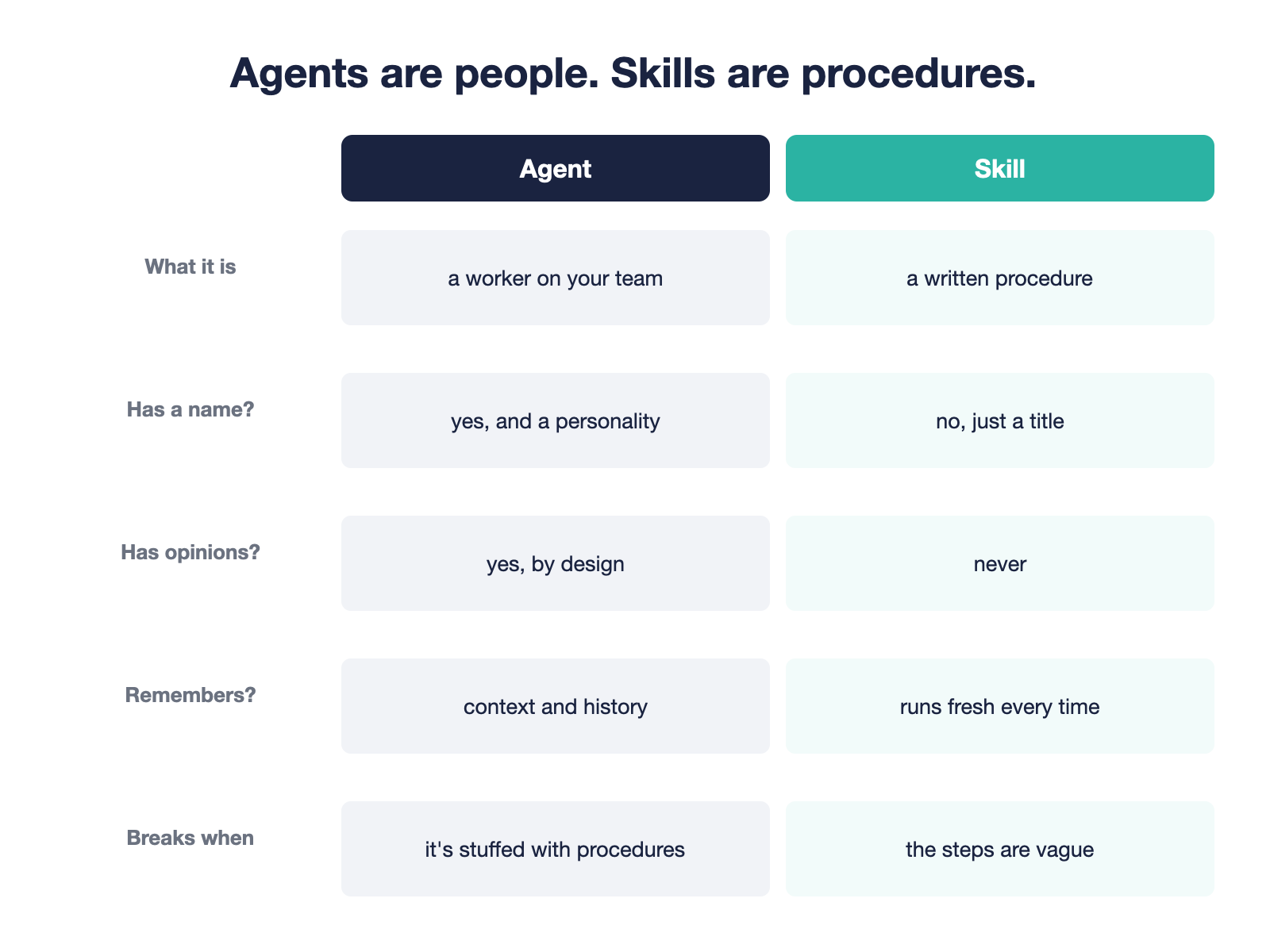
An agent is a person on your team: named, opinionated, persistent.
A skill is a procedure they follow: staged, repeatable, written down.
One person follows many procedures.
One procedure can be followed by many people.
Now the honest mechanics paragraph, for the technical readers asking the Claude skills vs agents question specifically.
In a tool like Claude Code, a skill is a markdown file of instructions that runs when invoked, and an agent typically gets its own isolated context to work in.
Anthropic’s own docs cover the mechanics well in the Claude Code skills documentation.
And if you want the full agents vs skills vs workflows taxonomy, with file conventions and a three-tier hierarchy, Daniel Miessler’s guide is the best power-user version.
But the mechanics are not why people stay confused.
People stay confused because every explanation starts with context windows instead of starting with the company.
What a Skill Looks Like in a Real System
So what is a skill in AI, concretely?
Here’s a real procedure from my own setup: the weekly business report.
It’s a written skill with stages.
Pull the revenue numbers from every payment source.
Pull the email list growth.
Pull the site analytics.
Ask me four questions the data can’t answer.
Compose the report in a fixed format.
Have my analyst deliver the briefing.
Notice what this is: a checklist with quality gates.
It has no personality.
It has no opinions.
It doesn’t remember last week.
It’s a procedure, sitting in a file, waiting for someone to run it.
That’s a skill.
If you’ve ever written a standard operating procedure for a human employee, you already know how to write one.
My whole content operation runs on skills like this, including the ones that turn my meeting transcripts into a knowledge base.
What an Agent Looks Like in a Real System
Now meet Ken.
Ken is my business analyst.
He has a name, a personality file, and standing opinions about my numbers.
He benchmarks everything against industry data, he’s skeptical of vanity metrics, and he opens every briefing the same way.
When I ask “Ken, what do you think about this funnel?”, I’m not invoking a procedure.
I’m asking a colleague who has context, history, and a point of view.
That’s an agent: a worker, not a workflow.
Ken lives inside my organizational brain, reading the same knowledge base every other part of the system reads.
And the naming isn’t decoration.
A named agent with a personality file produces consistent judgment across months of work, because the personality IS the configuration.
In my workshops I push this further: treat your main AI as a co-founder.
Mine helps me design and build all the other agents.
It naturally reads their personality files and learns how each one is built.
The co-founder builds the team.
The Part That Breaks Brains: They Call Each Other
Here’s where my student got stuck, and where you might be stuck too.
You’d expect a hierarchy: agents on top, skills below, or the other way around.
There isn’t one.
They’re orthogonal.
In that workshop I finally said it in one line: the skill can activate the agent, and the agent can activate the skill.
Both directions are real, and my own system runs both daily.
Direction one: my weekly-report skill summons three different agents.
The procedure runs, and at specific stages it calls Ken for the analysis, my operations agent for the execution view, and an assistant for the formatting.
One procedure, three workers.
Direction two: my LinkedIn-writing agent runs a multi-stage pipeline skill.
One worker, executing a long written procedure with drafts, edits, and quality gates.
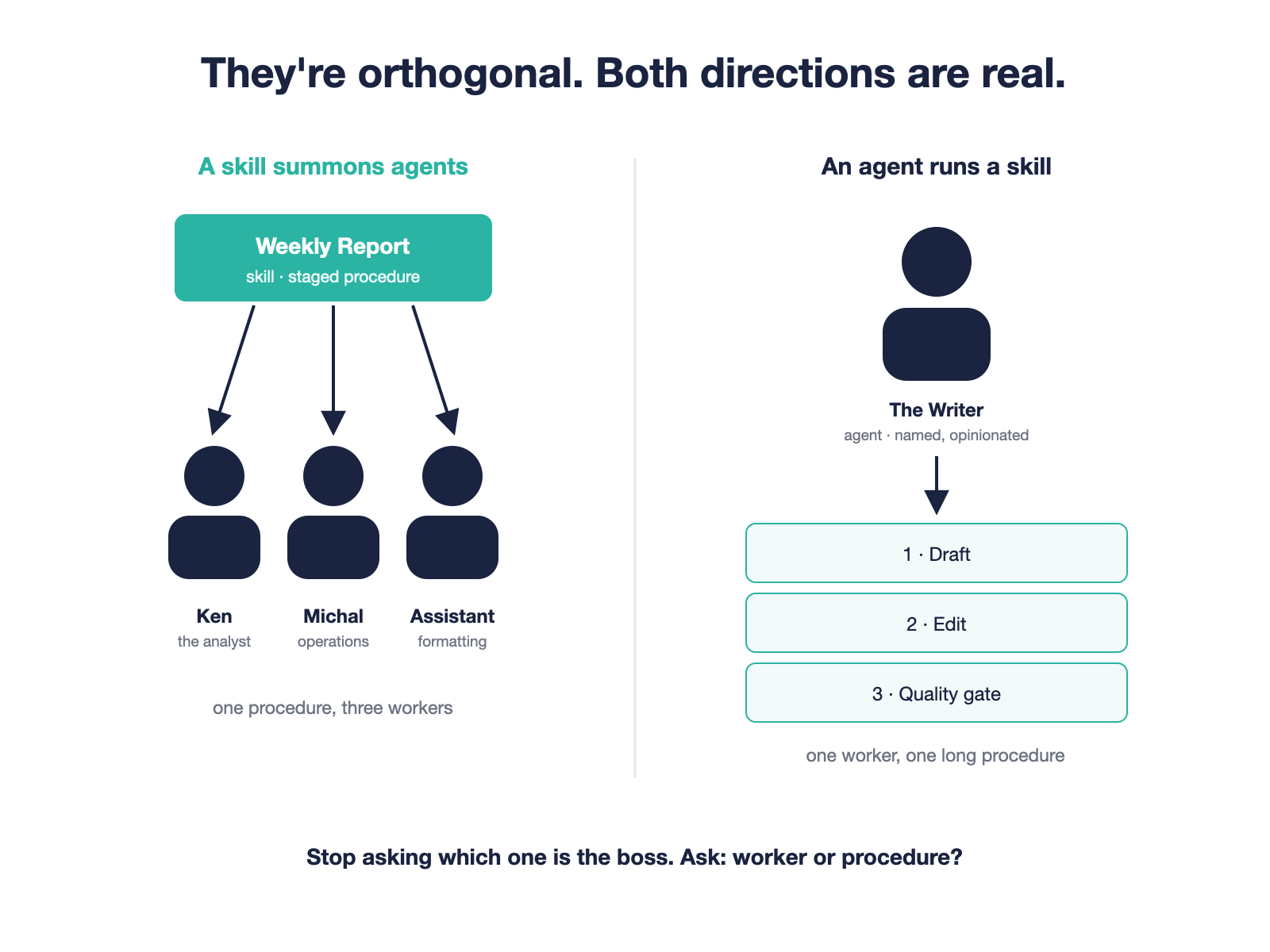
So stop asking “which one is the boss.”
Ask instead: is this thing a worker or a procedure?
That single question classifies everything in your system, and it’s the real answer to when to use an agent vs a skill.
A worker, when the job needs judgment, voice, or memory.
A procedure, when the job needs consistency.
Which to Build First (the Beginner’s Decision Rule)
Now the practical implication my student was really asking for.
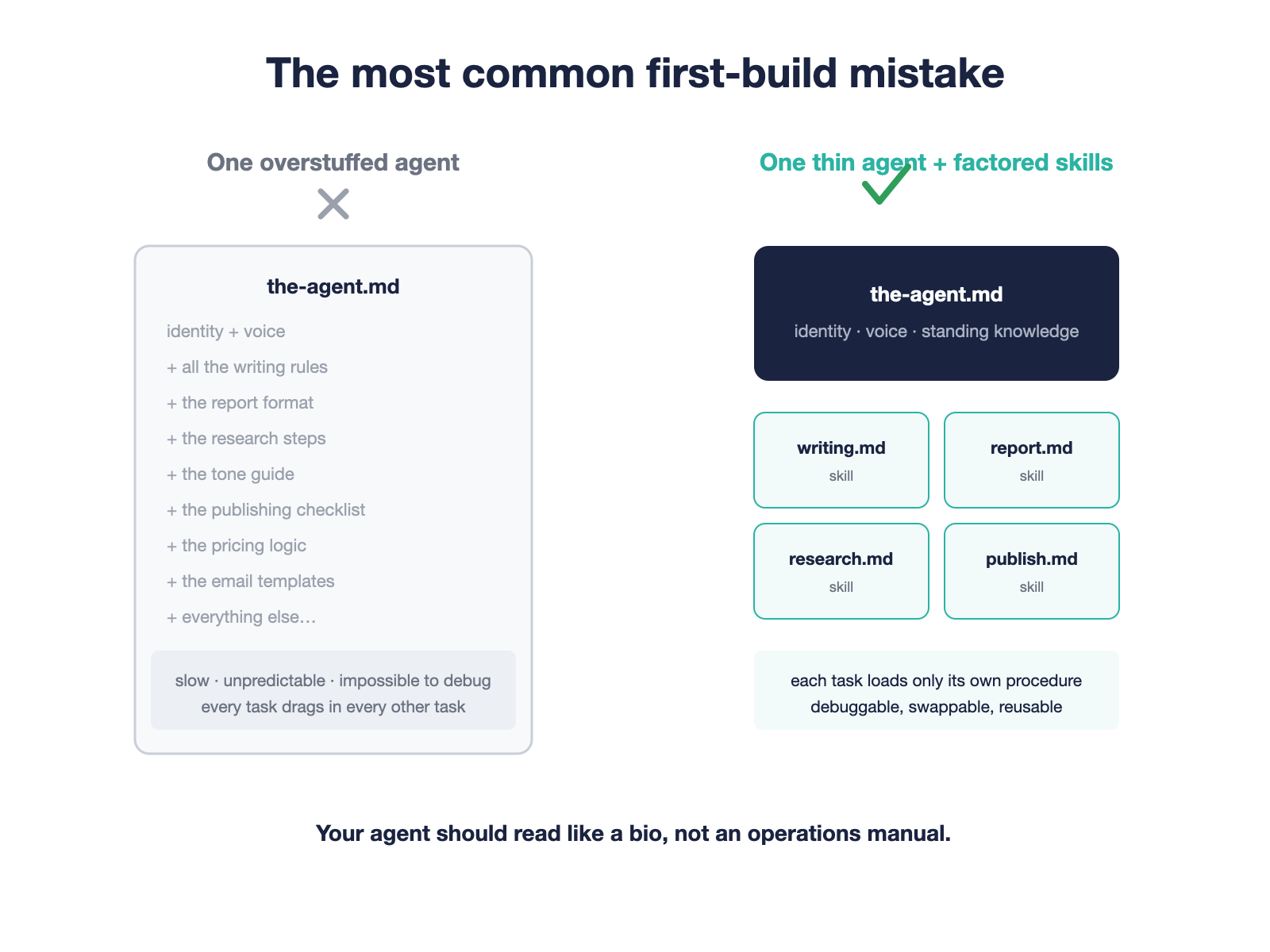
Of all the AI agent design mistakes I see, one shows up in almost every first build: the overstuffed agent.
Everything gets crammed into one agent’s instruction file: the writing rules, the report format, the research steps, the tone guide, the publishing checklist.
The file grows to thousands of words.
The agent gets slower, less predictable, and impossible to debug, because every task drags the instructions of every other task into context.
The fix is factoring.
Keep the agent thin: identity, voice, standing knowledge.
Move every repeatable process out into its own skill file.
Your agent should read like a person’s bio, not like an operations manual.
And here’s my decision rule for beginners, the one I now teach explicitly.
Start with ONE agent, your co-founder, plus as many skills as you have repeatable processes.
Add a second, named agent only when a job genuinely needs a different personality or its own isolated context: a skeptical analyst, a legal reviewer, a writer with a distinct voice.
I’ll be honest about the tradeoff, because it’s a real open question in how I teach this.
Named agents with personalities are more powerful, and they’re also more cognitive load.
Some of my students thrive on the team-of-characters model from day one.
Most do better with one co-founder and a folder of procedures, growing the cast later.
This is one concept out of the full system I teach in my workshops and build with mentoring clients, and it’s the one I make everyone master first, because every other design decision sits on top of it.
FAQs
Is a slash command a skill?
In practice, yes.
A slash command is a skill you trigger by name: a written procedure that runs when called.
The invocation method is a detail; the procedure is the thing.
Can a skill work without an agent?
A skill is inert text until something executes it.
Whether that executor is your main AI session or a named agent, the procedure needs a worker.
That’s the cleanest proof they’re different kinds of things.
How many agents should a solo builder have?
Start with one.
Add a named agent when a job needs a different personality or isolated context, not before.
I run a full business this way and my cast grew one character at a time, each one earning its place.
Are agents and skills a Claude-only concept?
The vocabulary shifts by vendor, and that’s half the reason for the confusion.
But the underlying split, workers versus procedures, shows up in every serious agentic system.
Learn the distinction once and you’ll recognize it everywhere.
The next time someone uses the two words interchangeably, you’ll feel it.
A worker is not a workflow.
Build your team accordingly.
Sources
Thousands of builders are already inside. Questions, builds, and what actually works.
Claude Cowork vs Claude Code: Which One Should You Use? (2026)
Same engine, different steering wheel. A builder's honest breakdown of Claude Cowork vs Claude Code: pricing, real token costs, and which to actually pick.
How to Run AI Agents in the Cloud 24/7: Local vs VPS vs Managed (and the BYOK Move That Cuts the Cost)
Local, VPS, or managed? The true cost of running an AI agent 24/7, including the token bill nobody mentions, and how BYOK cuts it 60 to 80 percent.
איך מריצים סוכני AI בענן 24/7: מקומי מול VPS מול מנוהל, והמהלך של BYOK
מקומי, VPS, או מנוהל? העלות האמיתית של הרצת סוכן AI מסביב לשעון, כולל חשבון הטוקנים שאף אחד לא מזכיר, ואיך BYOK חותך אותו ב60 עד 80 אחוז.